
No amount of positive framing substitutes for support, but tolerance for uncertainty allows life to happen in the gap between what we planned and what actually arrived.
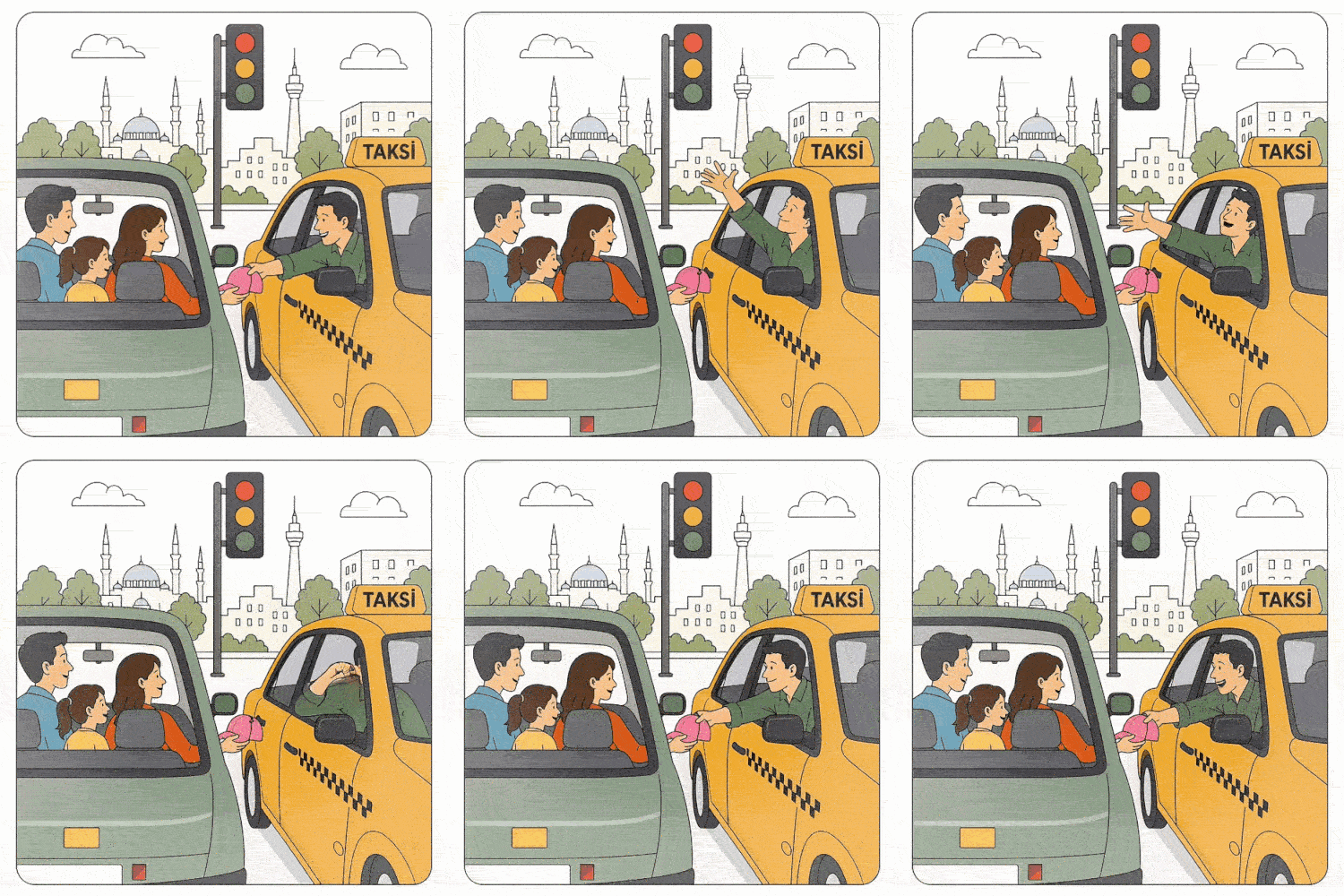
My children and I were in the back of a taxi when another yellow cab swerved up beside us at a red light. The driver was leaning halfway out his window, waving our driver down with enormous conviction. Our driver rolled his window down. The other driver held out a small baseball cap. My daughter’s cap. Only then did I recognize him.
Aytekin had driven us home from the grocery store one afternoon, and somewhere between unloading the bags and getting everyone upstairs, my three-year-old daughter’s baseball cap slipped into the back seat without any of us noticing.
We were newly arrived in Ankara then, still in the stage of a posting where every supermarket trip feels faintly absurd: a trunk full of jars whose labels you can’t yet read, snacks bought mostly to reassure small children that some parts of life remain recognizable.
He had spotted us through the rear window of a different taxi, nearly twenty-four hours later, in a city of five million people. He’d kept the cap on his dashboard all day, he explained, hoping he might cross paths with us again. He had daughters of his own, close in age to ours.
The light changed. The taxis drifted apart. But that was the beginning of a new friendship. Over the next four years, Aytekin became our regular taxi driver, and then something harder to name, the person who explained the country to us in pieces, one ride at a time. He taught us which holidays emptied the city and which filled it, why a particular neighborhood smelled like grilling meat on certain evenings, how to tell the difference between politeness and genuine welcome (and how often, in Turkey, they turn out to be the same thing). He corrected my terrible pronunciation patiently and laughed at it warmly.
What should have been a forgettable fifteen-minute ride home from the grocery store became one of the defining friendships of my years in Turkey.
I think about that often… how the moments that reshape our lives rarely announce themselves.
Sometimes they just pull up beside you at a red light, yelling in a language you don’t yet speak, holding out something small that you didn’t even know you’d lost.
None of this appeared anywhere in our pre-posting briefings
We prepare for postings as though they are projects to be managed. We make checklists. Read briefing notes. Attend cross-cultural training. Research schools, neighbourhoods, visas, shipping timelines, medical systems. None of this is unnecessary. Anyone who has lived through an international move without preparation understands very quickly why the preparation exists.
But preparation is not where life happens. Life happens in the gap between what we planned and what actually arrived. And whether that gap feels like a threat or an opening depends less on circumstance than on our relationship with uncertainty itself.
Intolerance of uncertainty
Michel Dugas, a psychologist at the Université du Québec en Outaouais who has spent decades studying what he calls intolerance of uncertainty, describes an exhausting temptation to over-manage every possible outcome because uncertainty feels inherently unsafe.
Dugas’s work is hopeful precisely because it argues that this reaction is not fixed. It is learned. Which means it can also be unlearned.
The treatment approach he developed relies heavily on what psychologists call behavioral experiments. Instead of avoiding uncertain situations, patients deliberately enter them. They test catastrophic assumptions against reality. They discover, gradually and repeatedly, that uncertainty is survivable. Sometimes even rewarding.
The logic is surprisingly simple: tolerance for uncertainty behaves a bit like a muscle. It strengthens through exposure. Which means diplomatic life, whether we intended it this way or not, functions as one enormous behavioral experiment.
We move countries without fully understanding what awaits us. We accept friendships we cannot predict and losses we cannot prevent. We leave baseball caps in taxis we assume we will never see again.
The uncertainty is guaranteed
What varies is whether we experience that uncertainty primarily as danger or as possibility.
There is a beautiful word for what sometimes emerges when uncertainty is held the right way: serendipity.
Horace Walpole coined the term in the eighteenth century after reading a Persian tale about the princes of Serendip, travellers who repeatedly discovered things they were not searching for because they remained observant enough to notice them. Later, the sociologist Robert K. Merton refined the idea further: serendipity is not mere luck. It is the intersection of accident and preparedness — chance recognized by an attentive mind.
Serendipity is not a cure
Not every experiment succeeds. Serendipity is not a cure for loneliness, marital strain, burnout, difficult postings, family separation, or mental illness. There are seasons of diplomatic life where openness becomes genuinely difficult because exhaustion leaves very little emotional margin for curiosity.
No amount of positive framing substitutes for support. The research on adjustment abroad is very clear about this: social support matters enormously. Community matters. Access to mental-health care matters. Sometimes the correct response to uncertainty is not increased openness but increased help.
One of the most humane aspects of Dugas’s work is precisely this recognition. People do not build tolerance for uncertainty through force of will alone. They often build it gradually, relationally, with support systems around them. No one adapts entirely by themselves.
And there is one practical caveat the research keeps surfacing: heavily scheduled days actually contract the experience of time itself, leaving very little room for the unplanned to arrive (Tonietto, Malkoc, & Nowlis, 2018). Margin is not a luxury. It is the precondition.
The accidental friendship
Some of the strongest relationships I have formed abroad began with moments so small they barely registered at the time: a misplaced cap, a conversation at a school gate, borrowing a phone charger, asking someone where they buy coffee beans. Sociologist Mark Granovetter famously argued that these kinds of loose social connections — what he called weak ties — often matter more than our closest relationships because they connect us to worlds we do not already inhabit.
And the stakes of these loose ties are not soft. Recent public-health research treats social connection itself as a measurable determinant of mental and physical health — comparable in effect to factors we have long taken seriously, like smoking or blood pressure (Holt-Lunstad, 2024).
Diplomatic life generates weak ties constantly. The real question is whether we allow them to deepen.
Whether we stay for the second coffee. Whether we accept the invitation. Whether we wave back when the taxi driver recognizes us in traffic.
The accidental career
Almost every diplomatic spouse or partner has a story that begins with disruption. A career interrupted by relocation. A volunteer role accepted provisionally. A freelance project taken initially for survival. And then, gradually, a new professional identity emerged from circumstances nobody would have chosen deliberately.
Career theorist John Krumboltz called this planned happenstance: the recognition that meaningful careers are often built not through rigid planning but through responsiveness to unexpected opportunity.
The painful side of this reality is well documented. Diplomatic mobility regularly damages professional continuity, especially for spouses and partners. But research also suggests that adjustment and social support strongly shape long-term life satisfaction abroad. Some of what is lost through movement is rebuilt in forms we could not have predicted at the beginning.
A broader review of expatriate family adjustment finds the same pattern across postings and sectors: the loss of established support systems is one of the most consistent predictors of strain, and its slow rebuilding is one of the most consistent predictors of recovery (Sterle, Fontaine, De Mol, & Verhofstadt, 2018).
The accidental belonging
There is a moment in almost every posting when a city stops feeling purely foreign. Usually the shift is small enough that you miss it while it is happening. The fruit seller asks where you were last week. You stop translating every interaction internally before speaking.
The sociologist Ray Oldenburg described places like cafés, bookstores, parks, and neighbourhood restaurants as third places: the social environments that exist between home and work where belonging develops slowly through repetition rather than intention.
Repetition alone, of course, is not the mechanism. What psychologists call savoring — the small, deliberate attention paid to ordinary unfolding moments — appears to be the bridge between mere familiarity and felt belonging (Pezirkianidis et al., 2023).
You do not think your way into belonging. You practice your way into it. One familiar place at a time.
The accidental self
Political sociologists who study diplomatic careers often note how rarely international lives unfold according to original plans. The biographies become nonlinear. Identities evolve unevenly across countries, languages, friendships, and losses. The version of ourselves that accepted one posting often bears only partial resemblance to the version that leaves the next.
I sometimes think about the parent sitting in the back of that Ankara taxi years ago with small children, weak Turkish, and a trunk full of groceries bought in mild confusion.
He would not entirely recognize the person writing this now from São Paulo.
And yet the distance between those two people was built precisely through these accumulated accidents: friendships, failures, adaptations, reinventions, griefs, recoveries, ordinary Tuesdays that became turning points only in retrospect.
There is a temptation to turn serendipity into a strategy. It is not.
Serendipity is what occasionally arrives when we tolerate uncertainty long enough for chance to do its work.
The actual practice is far less glamorous.
- Walk somewhere new without checking the map first.
- Accept one invitation you would normally avoid.
- Become a regular somewhere before the first six months pass.
- Ask someone where they go for coffee.
- Talk to the parent beside you at the school gate.
- Stay five minutes longer than feels comfortable.
- Wave back when the taxi driver pulls alongside your car in traffic.
None of this is sophisticated. All of it, in Dugas’s language, qualifies as a behavioral experiment.
Psychologists also have an unromantic name for what these small returns do: capitalization, the way responding to or briefly sharing a positive moment quietly strengthens the bond in which it occurred (Lambert et al., 2012). Waving back is not a metaphor. It is the mechanism.
Aytekin still drives a yellow taxi somewhere in Ankara. His daughters are older now. So is mine. The cap itself is probably buried in a box somewhere, from our recent move from Kazakhstan to São Paulo.
It no longer matters. What matters is that a lost child’s baseball cap once cracked open the careful structure of a newly arrived family’s life just enough to let another human being enter it.
And that, over time, I have come to understand, is how much of diplomatic life works. Every few years we hand ourselves back to uncertainty. If we are lucky, and open, and patient, and supported, uncertainty occasionally hands something unexpected back. A friendship. A language. A new version of ourselves. There is no checklist for that. There is only a way of paying attention.
And most of us learn it the same way we learn nearly everything important in this life: by accident.

Former journalist for the CBC, Patrick has been abroad for a decade. From Turkey to Kazakhstan, he is now in Brazil. His family changed a lot since he arrived in Turkey with 3 young children. His career path also changed, from learning to register a business for international freelance work to contributing to several small contracts at missions, Patrick found his way to build a professional life that he can carry with him.
Selected references
- Behavioral Experiments for Intolerance of Uncertainty: Challenging the Unknown in the Treatment of Generalized Anxiety Disorder
- The diplomatic spouse: Relationships between adjustment, social support and satisfaction with life
- Gendering Diplomatic Careers. Distance and Time in International Assignment Practices Among 600 French Diplomats
- The Travels and Adventures of Serendipity: A Study in Sociological Semantics and the Sociology of Science
- Expatriate Family Adjustment: An Overview of Empirical Evidence on Challenges and Resources
- Embracing uncertainty: the serendipity of diplomatic life
 Explore how tolerance for uncertainty can transform your diplomatic experience.
 - An unexpected currency
 We sometimes live in places where a little effort can go a long way. Across posts, canadians are finding their own ways to contribute locally.
 - Expat expectations
 Reflexion on the challenges and identity shifts faced as a diplomatic spouse.