
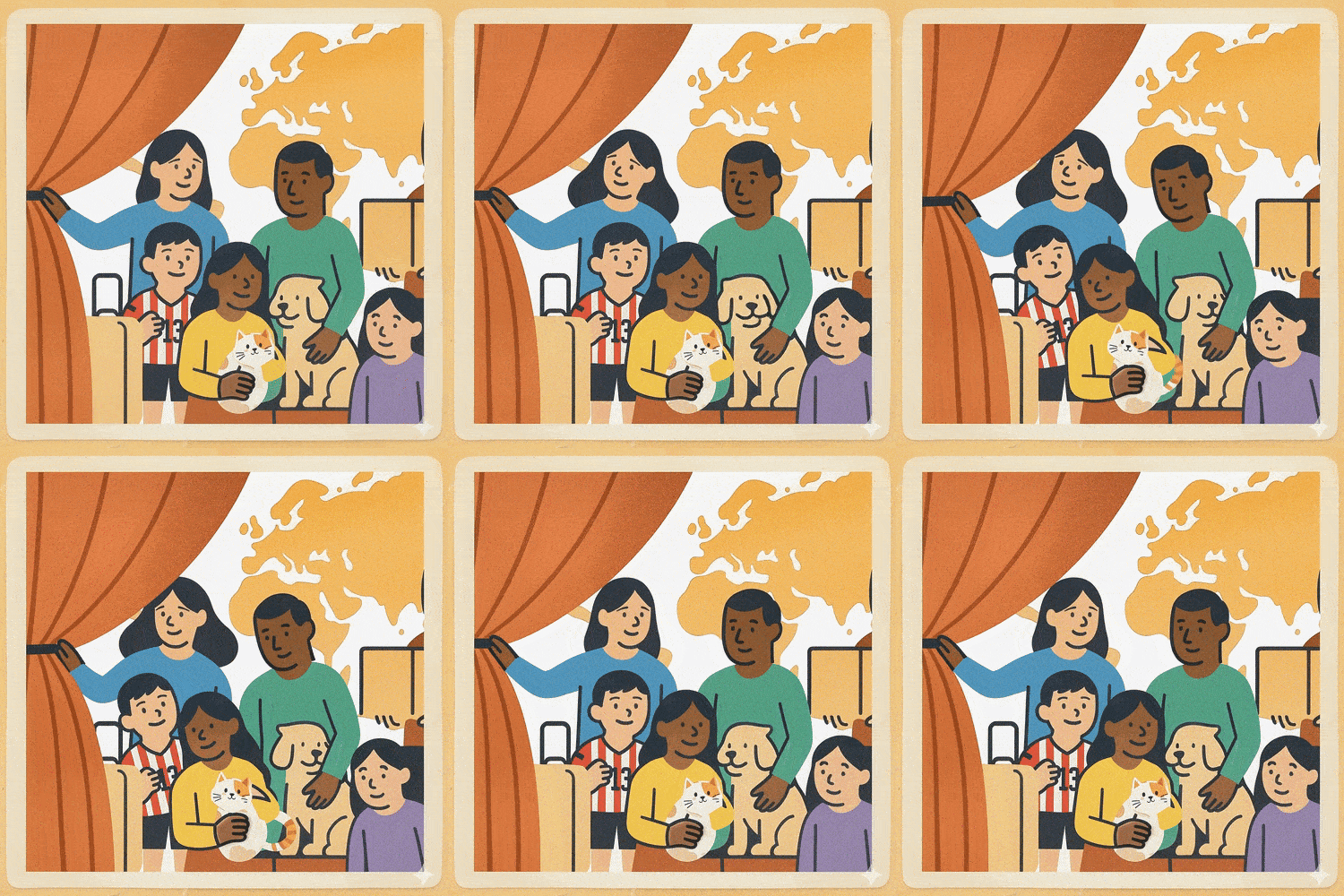
Loading the Elevenlabs Text to Speech AudioNative Player…Spouses of the World: Bullet Dodging Behind Diplomatic Glamour. Edited by Linn Eleanor Zhang. Kent, UK: Sabrestorm Stories Ltd, 2021. ISBN 978-1913163013. (244 pages)
You know the paradox: our lives are rich with opportunity, but layered with disruptions most people don’t see. Spouses of the World: Bullet Dodging Behind Diplomatic Glamour, offers something rare: a place where our experiences are understood without explanation. It isn’t a how-to manual or a glossy travelogue. It’s a room full of peers saying, “We get it.”
Honest stories, compassionate tone
These sixteen voices don’t compete in hardship; they compare notes on real life. Expectations versus reality. Careers paused and reimagined. Children building identities across languages and continents. The tone isn’t bitter, it’s clear-eyed and generous.
Contributors hail from Malaysia, Canada, Slovenia, Colombia, Israel, and beyond. Their stories echo the reality of Canadian diplomatic families: frequent relocations, cultural adaptation, different schooling systems, identity shifts, and professional sacrifice.
Whether you are a first-time spouse preparing for departure, a seasoned partner juggling multiple moves, or a foreign-born spouse trying to navigate identity, you will find your own reflections in these pages.
Reading these stories feels like having coffee with peers who have “been there.”
There’s a particular kind of loneliness that comes from living an experience no one else seems to understand. You’re at a dinner party back home, and someone asks brightly, “How’s life in [insert exotic city]? It must be so great!” You smile and say something vague about adjusting well, because what else can you say? That you spent a morning struggling in a supermarket because you couldn’t read the labels and the clerk spoke too fast and you suddenly couldn’t remember why you agreed to this life? That your spouse worked late again and you ate dinner alone? That you are wondering who you are now that your career is gone and your friends are scattered across continents?
Most people don’t say these things. Not because they’re not true, but because saying them out loud feels like betraying some unspoken contract, the one where we have to be grateful for this extraordinary opportunity, adventurous enough to handle anything, and resilient enough not to need help. Posting carefully curated photos on social media, and carrying your struggles in silence often becomes the norm as most people don’t want to hear about the cost of what they perceive as a privilege. Of course we are lucky! But it comes with unique challenges.
Stories about diplomatic spouse life are difficult to find. There are practical guides: how to pack an overseas shipment, what vaccines you need, how to find international schools. There are also glossy magazine features about embassy dinners and exotic locales. There are blog posts that maintain the cheerful tone of travelogues even when discussing hardship. But stories that simply *witness* the complexity of this life, that sit with you in the difficult feelings without rushing to solve them or frame them positively, these are rare.
Perhaps this scarcity exists because diplomatic spouses occupy a strange social position: privileged enough that complaining feels ungracious, struggling enough that the privilege doesn’t solve all your problems, and isolated enough that finding others who truly understand becomes its own challenge. Not quite an expat (our spouse’s work shapes everything), not quite a trailing spouse in the corporate sense (the diplomatic context adds unique opportunities and challenges), not quite local anywhere. We belong to a category so specific that finding our own stories reflected back feels nearly impossible.
The forewords from prominent figures including Marina Wheeler , Phil McAuliffe (The Lonely Diplomat), and Markku Keinänen (former Permanent Representative of Finland to the EU), acknowledge both the resilience of spouses and the pressing need for institutional support. Their remarks underscore a central message: diplomacy functions best when families thrive.
What the book doesn’t do
This anthology doesn’t provide simple solutions, step-by-step guides, or reassurance that everything will be fine. It doesn’t minimize the costs of diplomatic life or pretend that a positive attitude solves structural problems. What it does instead is bear witness. It says: this is hard, and you’re not imagining it. It says: others have walked this path. It says: there are strategies, there are resources, there is community, but ultimately you’ll have to find your own way through.
The glamour myth and why it matters
The book’s subtitle, “Bullet Dodging Behind Diplomatic Glamour,” immediately signals its dual purpose. Yes, there are dinners with dignitaries, but as Agnes Fenyvesy writes about her London posting, the reality quickly diverged from her carefully selected wardrobe of formal attire. The embassy staff were too busy to welcome newcomers properly, financial cuts meant fewer spousal invitations, and the fairy-tale vision of constant receptions evaporated into long days alone while her husband worked late hours.
This tension between expectation and reality runs throughout the collection like a thread binding disparate experiences into a coherent whole. Understanding this gap matters profoundly for families preparing for posting. The “Ferrero Rocher Princess” stereotype, as Carmen Davies acidly terms it, doesn’t just create unrealistic expectations; it actively isolates spouses by making their genuine struggles feel illegitimate. If everyone believes you’re living a fairy tale, who wants to hear about your difficulties finding a tax advisor aware of your unique situation or about your career derailing for the third time?
Career and identity
The stories reveal that there is often a dismantling of professional identity that accompanies many diplomatic postings. Each move can mean not just finding new work but redefining what work could mean in contexts where qualifications weren’t recognized, where language barriers existed, or where diplomatic spouses simply weren’t permitted to work.
The book excels at showing how this career disruption compounds over time. “Without a business card to exchange at events, people simply moved on.” The message was clear: in diplomatic circles, you are what you do professionally, and if you’re “just” a spouse, you may as well not exist.
After years of following a spouse’s career, diplomatic spouses face “a patchy work history, or none at all,” reduced pension prospects, and qualifications that may be “out of date.” The book doesn’t offer false reassurance, but it does offer strategies.
The friendship paradox
Perhaps no relationship complication emerges more poignantly in the book than the friendship paradox: the knowledge that any friendship you develop with host country nationals has a built-in termination date. Several contributors address this directly.
Britten Holter, writing from the perspective of a diplomatic child, articulates this with striking clarity: “The friendships I built up during postings did not last. I asked both of my brothers whether they are still in contact with some of their friends from any of the posting countries. Both of them said no.” She describes trying to protect herself by “not getting too attached to people, but still it happened.”
Marzia Brofferio Celeste adds an adult perspective to this dynamic: “Some old friends will not be so close anymore, but that means there will be space for new friendships, probably more tuned to the new person I have become.” She’s describing a kind of triage, accepting that you’ll lose some relationships to make space for new ones more suited to who you’re becoming.
The book suggests that this pattern creates a particular approach to friendship: intense but temporally bounded. Agnes Fenyvesy describes developing close relationships: “I have maintained a good relationship with the participants I met… Through these wonderful people, I have learned about politics, education, healthcare and life in places like Hungary, Mexico, Switzerland, South Korea, Turkey, Tunisia, Colombia, Slovakia and Iran.” These are rich, meaningful connections, but also ones that everyone involved knows will primarily exist in a bounded timeframe.
This friendship paradox affects relationships with host country nationals particularly acutely. When Nina Rousu writes about her Ugandan nanny or Kenyan staff, she’s describing people who became essential to her family’s functioning and emotional well-being. But she also knew from the beginning that these relationships would end when the posting ended. The book suggests this knowledge subtly shapes the relationships themselves, they’re simultaneously genuine and provisional.
The particular concept of “home”
The book also explores returning “home”, the reverse culture shock that catches families unprepared. Marzia Brofferio Celeste devotes an entire chapter to her three separate experiences of homecoming to Italy, each more disorienting than the last.
Her framework is useful: after posting, she explains, there’s typically a “honeymoon” phase where everyone’s excited to see you. Then comes disillusionment as you realize that while you’ve changed, home has changed too, or rather, hasn’t changed with you. The butcher who made your favourite stuffed pork has retired. Your friends are discussing TV shows you haven’t seen and books you haven’t read. Your children’s school friends have formed bonds that exclude your kids. Most painfully, when you try to explain diplomatic life’s difficulties, people dismiss them: “You knew what you were signing up for.”
What makes Marzia’s insight valuable is her recognition that each homecoming teaches you how to do the next one better, but the first one is brutal. For her, the third homecoming to Rome, after London, worked because she had realistic expectations, arranged to arrive with time to settle before school started, and had learned not to fight systems that worked differently than she preferred.
Carmen Davies, the Mexican-born spouse of a British diplomat, adds another layer: foreign-born spouses often experience “home” as a place they never quite belonged to begin with. After decades abroad, she considers herself “belonging not to one country but to many,” truly globalized. But this cosmopolitanism comes at the cost of never quite fitting anywhere completely.
The foreign-born spouse: double displacement
Carmen Davies’ chapter explicitly addresses the unique challenges facing foreign-born spouses, those who weren’t born in the country their partner represents. As a Mexican woman married to a British diplomat, she faced not just the adjustments all diplomatic spouses face but an additional layer: learning her husband’s home culture, mastering his language beyond basic fluency, and constantly proving her legitimacy in a role that assumes shared nationality.
Foreign-born spouses must learn not just the language but the idioms, not just the culture but the unspoken assumptions, not just the etiquette but the subtle class markers that native-born spouses absorb unconsciously. She describes studying British culture and history with the intensity others reserve for professional qualifications, because in some ways, it became part of her professional qualification.
The book reveals how foreign-born spouses often become bridges: Carmen’s Mexican identity became an asset when her husband was posted to Latin America. Monica’s Italian design background helped her represent Latvian design services in London. But this bridge-building comes at a cost: constant performance of cultural competence, the pressure to be “more British than the British” or risk seeming insufficiently committed, and the loss of one’s own cultural identity in the constant work of representing another.
For Canadian spouses married to diplomats from other countries, or diplomats married to non-Canadian spouses, these chapters offer validation that the extra work they’re doing is real, substantial, and often invisible to others.
Children: the variable hard to control
Most people try to minimize the negative impact of diplomatic life on the youngest family members. Britten Holter’s retrospective, written as a young adult who grew up in diplomatic families, offers insights parents might miss in real-time.
She’s clear-eyed about the costs: each move meant leaving behind friendships just as they were deepening, changing school systems just as she’d mastered them, and the constant pressure to adapt while maintaining some core identity. But she’s equally clear about the benefits: linguistic flexibility, cultural fluency, and a comfort with change that serves her well in university.
Nina Rousu’s account of pregnancy and early motherhood while posted in Uganda and Kenya illuminates a different dimension: how diplomatic life affects not just children’s development but the experience of becoming a parent.
For foreign-born spouses, children raise particular complications around heritage, language, and belonging. Monica’s household, with an Italian mother, Latvian father, living in London, becomes a fascinating case study. Her son Vittorio was born in London, speaks Italian with her, Latvian with his father, and English at school. Monica worries constantly about maintaining each language and culture: “I really wanted my child to be trilingual as it was a good way to develop his three identities and cultures.”
But the book reveals how children of foreign-born spouses often develop primary allegiance to the host country rather than either parent’s country of origin. Monica notes: “I would say that he is an Englishman as he was born in London and has experienced daily life and society only in Britain.” Despite her Italian heritage and his Latvian citizenship, Vittorio identifies as English, a development that Monica seems to accept with mixed feelings.
The linguistic dynamics in Monica’s household illustrate broader patterns. Though her husband speaks to Vittorio in Latvian, the boy usually answers in Italian. Latvian remains his weakest language, and he actively resists it: “When my husband starts a conversation in Latvian, my child sticks to answering in Italian. After a while, my husband switches to Italian, too.” The power dynamics of language preference in the household reveal that even with parental determination, children make their own choices about cultural belonging.
Carmen’s experience adds historical depth to this question. Her parents left Indonesia for Australia when she was 2, and she grew up speaking “a mixture of Bahasa, Sundanese, Dutch and English, but as a child I always responded to my parents in English as it was the language I was most confident in.” When she later had the opportunity to live in Indonesia during a posting, she found herself reconnecting with family but ultimately concluding: “I feel I have roots in Indonesia and a strong sense of belonging, but it is not my home.”
Mental health: the unspoken crisis
Julia Gajewska-Pratt’s chapter on surviving a Khmer Rouge attack in Cambodia during her husband’s posting stands out for its unflinching examination of post-traumatic stress disorder (PTSD) in diplomatic families. Her description of lying in a hotel corridor while rockets exploded outside, then having to navigate the next day as if life were normal, captures the surreal quality of crisis in diplomatic life.
But what makes her account invaluable is what came after: the panic attacks that continued for years, the avoidance of enclosed spaces, the way fireworks could trigger flashbacks decades later. She details the therapy she received (and the therapy she didn’t receive but should have), the way her family had to learn to accommodate her triggers, and the slow process of recovery.
The book makes clear that mental health struggles in diplomatic families face unique barriers: the fear that seeking help will harm your spouse’s career, the lack of continuity in care as you move between posts, and the isolation that makes it hard to recognize when you’re in trouble.
Male spouses: the invisible minority
The book’s final section, “The Male Diplomatic Spouses,” is frustratingly brief—a few short vignettes rather than full chapters, but this brevity itself tells a story. The editor’s note explains that despite extensive outreach, few male spouses agreed to contribute. The ones who did reveal why: many don’t identify as “diplomatic spouses” at all, especially if they came to the posting with their own jobs.
The fragments we get are telling. One man describes the “eternal search for a job” and how a three-year employment gap on his CV became an insurmountable barrier. Another discusses the expectation that “men are expected to work” and his discomfort with the idea of being financially dependent. A third found salvation in sports, having his familiar rugby back on TV after eleven years felt like returning home.
These voices matter because they reveal how gendered the diplomatic spouse experience remains. Women are more likely to be asked about their sacrifices; men face assumptions that they must be working. Women build communities with other spouses more easily; men may be excluded from “diplomatic wives” clubs or feel uncomfortable in female-dominated spaces.
Neither tourist nor local
Multiple contributors describe occupying an in-between space in host countries, not tourists (you live there too long for that) but never truly local either. Carmen Davies describes how in Jakarta, “some people assumed I was a local” because of her Asian ethnicity, leading to uncomfortable moments when locals expressed surprise at her foreign status or made assumptions about her background. The ambiguity of her position, looking local but being foreign, created constant low-level friction in relationships.
The privilege problem
Running throughout these chapters is an uncomfortable but honest examination of privilege and how it shapes relationships in host countries. Multiple contributors note the vast economic gulf between diplomatic families and many host country nationals, and the complications this creates.
M. Mohammed writes about driving through Honduras: “Some days my heart sank, and I just wanted to burst into tears” seeing children begging, disabled people on streets, “women peddling trinkets with their tiny babies strapped on their backs, barefoot children walking the street in search of garbage to salvage.” She continues: “My diplomatic husband advised me to stay strong and treat everyone equally: it does not matter if you are the President of the Republic or the humble woman sweeping the road, you are human and you deserve to be treated with respect.”
This is admirable as philosophy, but the book shows how difficult it is to practice. When your children attend privileged international schools while local children beg on streets, when you have security guards while neighbors have none, when you can evacuate during emergencies while locals cannot, the structural inequality fundamentally shapes all relationships.
Emilia Atmanagara addresses this most directly in her discussion of volunteering: “I have met a diverse range of people, including those experiencing difficult life situations. It is a good reminder to be grateful for the life I have.” There’s something troubling about using others’ poverty as an occasion for your own gratitude, even when the intention is good and the volunteer work is genuinely helpful.
The book doesn’t resolve this tension but at least acknowledges it. Several contributors note that their diplomatic privilege creates both opportunities (to help, to connect, to learn) and barriers (the impossibility of truly equal relationships given the structural inequalities). Being conscious of this doesn’t eliminate it, but might make the relationships more honest.
Building communities, a lifeline
Agnes Fenyvesy’s chapter on founding the Diplomatic Spouses Club in London (DSCL) serves as both practical guide and philosophical reflection on why community matters. Arriving in London with grand visions of constant receptions and social events, she instead found herself alone most days, her husband working late, no automatic invitation to embassy events, and no obvious way to meet other spouses.
Her solution, creating the Diplomatic Spouses Club in London from scratch, demonstrates the entrepreneurial spirit many diplomatic spouses develop. What makes Agnes’s story particularly valuable is her honesty about the challenges of leadership: learning to delegate, dealing with volunteers who don’t follow through, managing the politics of an international organization, and the emotional difficulty of leaving everything behind when your posting ends. She’s clear that not all spouses want or need formal organizations, some prefer solitude or develop support networks organically, but for those who do need structure, her blueprint is available.
Final thoughts
Their collective message seems to be: diplomatic life offers extraordinary privileges, travel, cultural immersion, global friendships, personal growth, but these privileges come with real costs that shouldn’t be minimized or denied. Acknowledging the costs doesn’t negate the privileges; it makes the choice to continue more informed and intentional.
Diplomatic life asks families to rebuild themselves repeatedly, to sacrifice stability for adventure, to trade roots for wings. This book suggests that trade can be worth it, but only if we go in with eyes open, support networks ready, and the understanding that behind every champagne reception is someone who spent the afternoon figuring out how to manage his finances with several currencies, consoling a homesick child, or revising their CV again.
Spouses of the World never asks us to pretend. The essays aren’t audition tapes for who handled displacement best. They’re letters from people who learned, loved, risked, and kept going. Some started clubs. Some asked for help. Some found careers that travel; others discovered a vocation for making places kinder. All of them practiced the radical skill of naming their experience without shrinking it.
Spouses of the World: Bullet Dodging Behind Diplomatic Glamour. Edited by Linn Eleanor Zhang. Kent, UK: Sabrestorm Stories Ltd, 2021. ISBN 978-1913163013. 244 pp.

About the editor. Dr. Linn Eleanor Zhang is a researcher and educator focused on global mobility, expatriation, and multicultural lives. In this anthology she gathers sixteen candid essays from diplomatic spouses across continents and generations.
- Behind the curtain : Spouses of the World
 A great book that shares candid experiences of diplomatic spouses
 - What if ‘Where are you from?’ had no easy answer?
 Carissa Gobble’s book explores Third Culture Kids.
 - Globe-Trotter Academy Podcast
 Each episode dives into groundbreaking studies that uncover the hidden dynamics of living and working across cultures.