
Family-related issues are among the main causes of expatriate failures.
TL;DR:
Family adjustment plays a pivotal role in expatriate performance. Organizations must prioritize support systems for families to enhance both personal and professional success during international assignments.
When discussing expatriate success, a crucial yet often overlooked factor is family adjustment. Studies show a strong relationship between how well a family adjusts to a new country and how effectively the expatriate employee performs. This connection is explored in an insightful research conducted by Trompetter, Bussin & Nienaber : The relationship between family adjustment and expatriate performance.
Think of it like this: your energy and focus are limited. If you’re constantly worried about your spouse or kids, that stress spills over into your work (that’s the core of Spillover Theory!). In fact, around 30% of early expat returns or “failures” are directly caused by family adjustment problems. It’s a huge deal, and it shows why supporting the entire family isn’t just nice, it’s a smart business strategy.
The U-Curve: Knowing where you are on the ride
It helps to know that every family goes through predictable phases on this emotional rollercoaster, often called the U-Curve of Adjustment:
- 1. The Honeymoon: Everything is exciting! The culture, the sights, the newness. You’re on the first big climb.
- 2. Culture shock: This is the dizzying drop! Things stop being cute and start being frustrating. Language barriers, confusion, and loneliness can hit hard. Organizations need to intervene here—it’s the riskiest phase.
- 3. Adaptation: You start finding your feet, routines stick, and you build a local support network. You’re leveling out.
- 4. Mastery: You feel at home, confident, and can navigate life easily. You’ve reached the end of the ride, feeling great!
Understanding this curve means you know the dip is temporary.
Building your safety net
So, what makes a family better equipped for these twists and turns? It often comes down to internal strength: Family cohesion.
Families who adjust best share a few key traits:
- Open communication: Talking honestly about feelings and struggles.
- Adaptability: Being flexible when plans change (and they will!).
- Mutual support: Relying on each other for emotional strength.
This support is especially vital for kids. Their struggles with a new school curriculum or their lack of friends can ripple through the entire household. When organizations offer practical support like language tutors or help finding the right school, it’s not just about helping a child, it stabilizes the entire family unit, which leads to a more focused and productive employee.
How to get the support you need
- Do your homework: Proactively discovering every resource available.
- Advocate smart: Knowing how to ask for the support that isn’t obvious, in a way that makes it easy for them to say “yes.”
Step 1: Become an expert on the “available” resources
Don’t wait for a crisis to find out what’s available. GAC has support systems but many people do not know they exist.
- Read the Frequently asked questions and answers about foreign service directives (FSDs): Understand the relocation allowances or benefits summary. Read every line!
- Register to pre-posting sessions (there are several training sessions for “dependants”) or watch the recordings from previous years here. By understanding the “system” you’ll be able to ask relevant questions. It’s a lot to take in, but it will pay off.
- Find “go-to” persons: Identify people who can help you navigate the new location. Other Canadians, spouses or partners, expats from other countries, employees from the mission. These relationships can ease the transition!
- Don’t be afraid to ask questions: Every expat around you arrived at this place at some point, had to learn local habits, bureaucracy, banking, online shopping and grocery hacks. Get added to the local WhatsApp groups (Canadians & Expats); there are always communities where you can simply watch and learn, but also ask questions and even start contributing by sharing your own discoveries.
Step 2: Advocate smart
This is a core strategy. Separate the “survival” needs from the “would be nice” needs, and advocate for them in very different ways.
e.g. Logistics:
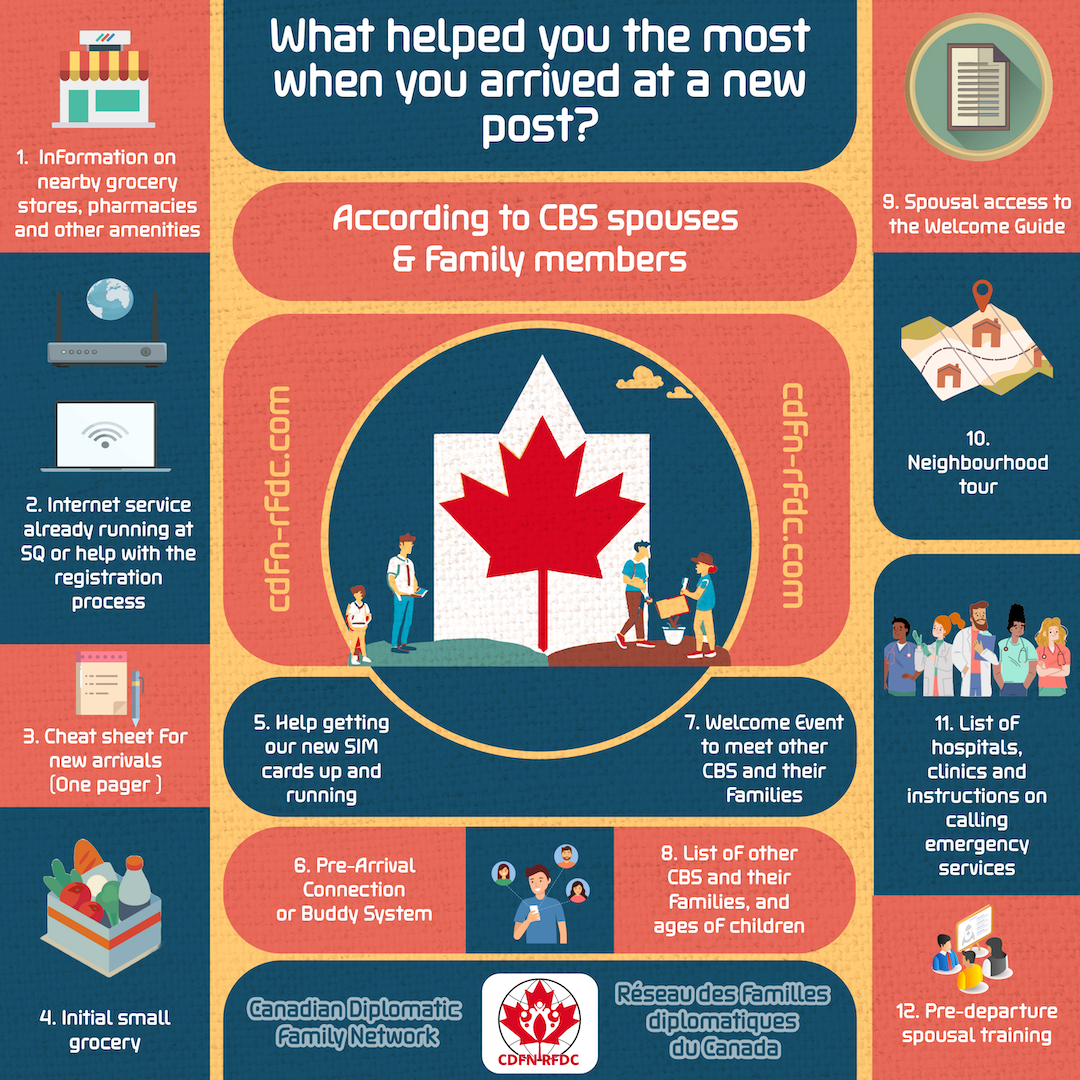
The pack-up kit (including the gravy boat 😛), figuring out how your new home functions (while it may be adapted to the local reality) and getting help with the basics such as SIM cards, Internet, shipment, local ID, etc. Make sure to read the entire “Welcome binder” to understand the processes. Your questions or request will be taken much more seriously if you read the documentation that the mission prepared before asking questions. Don’t forget that the team at the mission works with these cycles: greeting new employees and their families every year and trying to make the process go as smoothly as possible. If you understand the process but still have questions, then it is time to fill the knowledge gap.
When to advocate: immediately.
The local team does expect to have a few things to address. Be clear, factual and take into consideration the local reality. Perhaps you can ask other Canadians if some things are just common and you should learn to live with it. Remember that all requests must come from the employee but you can help document it, and make sure that when they fill up the request form at the mission, they have the right information.
Challenges faced by spouses
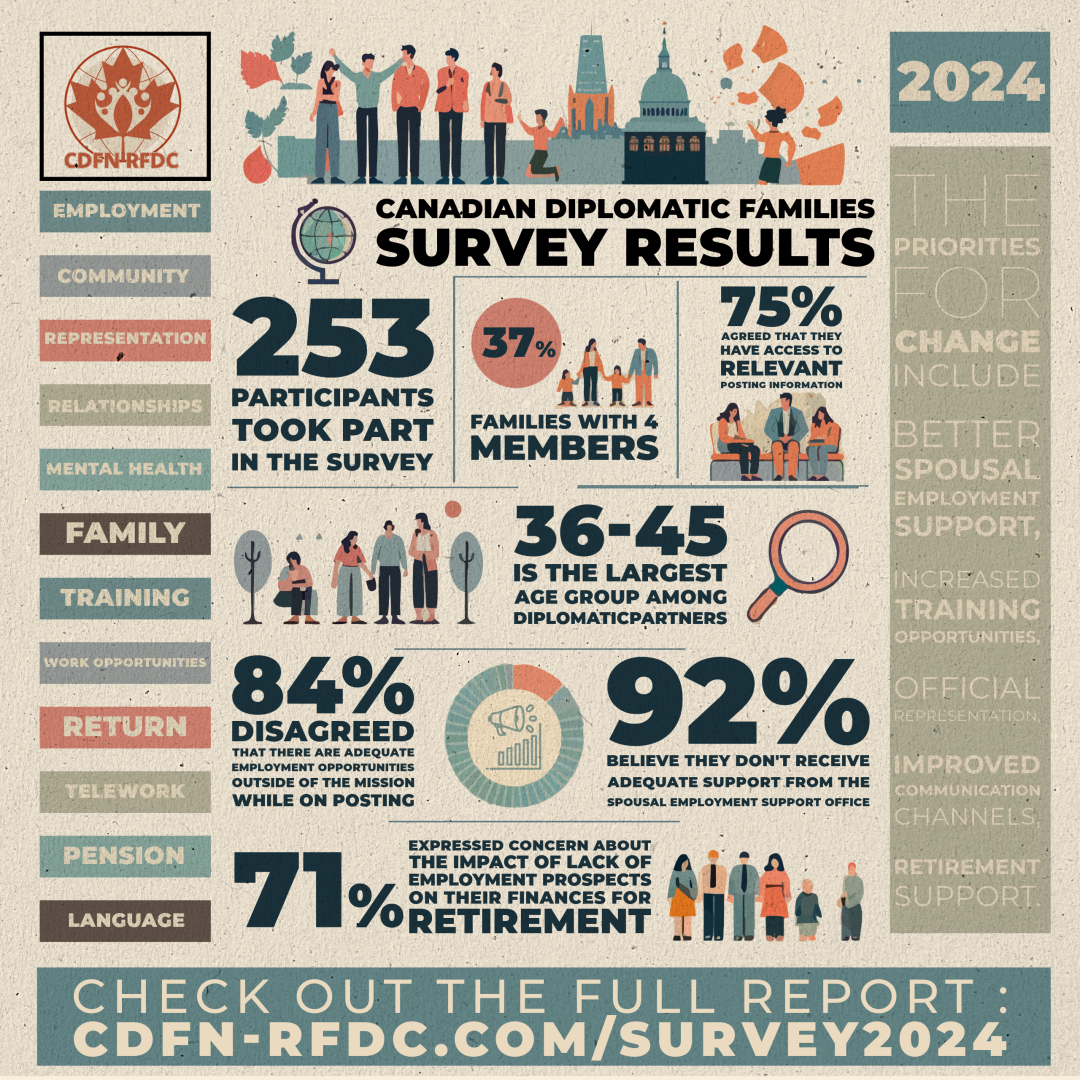
Relocating frequently leads to social isolation and even a loss of identity. The psychological impact can be profound. According to recent studies, nearly half of spouses report dissatisfaction due to these challenges. We touched on the topic earlier but let’s emphasize once more a few easy strategies:
- Join local networks: Engage in activities where other spouses or expats gather.
- Participate in social events (see our CDFN life hack about saying yes to invites for the first 6 months). It helps break the ice and form lasting friendships among expats.
We’re not the one making the policies, but we are living it. Our power lies in becoming a savvy “client” of the organization’s resources and being proactive to make the relocation a success!
Supporting links and studies
- The key study (Trompetter, Bussin & Nienaber): This study is a core source for the finding that family issues drive expatriate failure and is an excellent example of the research in this area. The relationship between family adjustment and expatriate performance
- Spillover theory & family cohesion (Academic review): This link provides a broader academic context for Spillover theory and the elements that contribute to successful family adjustment. Expatriate Family Adjustment: An Overview of Empirical Evidence on Challenges and Resources
- Organizational support and ROI: This resource discusses how company support is crucial for the family unit (including children’s adjustment) and directly impacts the success and return on investment (ROI) of the international assignment: Expatriate family adjustment: How organisational support on international assignments matters
- Adjustment Orientations of Expatriate Spouses: A Qualitative Exploration of Coping Mechanisms and Resource Dynamics
By Mitra Rezvani, (Thesis submitted to the Faculty of Graduate Studies of The University of Manitoba)