The CDFN is a not-for-profit volunteer group of GoC spouses working together to connect spouses and family members of GoC representatives at all diplomatic posts, and advocate for them.
Alongside the advantages of the diplomatic life (New places! New people! Adventure! Excitement!) are distinct challenges (Not knowing the local language! Navigating an unfamiliar city! No friends or family! Anxiety! Stress!)
Thankfully, Global Affairs has a counselling department that can help. The Office of the Well-being Ombud and Inspector General runs the Employee Assistance Program (EAP), which provides counselling to help manage stress, anxiety and other issues that can arise when working and living abroad — not just for employees, but for spouses and family members (15 years old and up), as well.
“Our EAP counsellors are here to help you make sense of what you are going through in your personal life or at work, and they work with you to identify the appropriate help,” the Office says in its 2023-2024 annual report. In addition to helping people manage distinct mental-health challenges, the service also supports individuals and groups during and after potentially traumatic events such as natural disasters or evacuations from post for safety.
The report offers insight into how the organization works, and the kinds of challenges it’s seeing among diplomatic families, based on what the Office heard from “visitors” from April 2023 to March 2024. (The organization uses “visitors” for people who use its services, instead of, say, “clients” or “complainants” to send the message that it tries to be impartial — instead of an advocate — in its work to help employees navigate workplace problems.)
Family challenges
The report notes that spouses and dependants come to counselling for a range of difficulties — challenges that may be familiar to anyone who has posted out. “We spoke with family members, including dependant children as young as 14, and they told us of the very real emotional and psychological challenges they face. Adjusting to new environments, schools and social dynamics — often leaving behind familiar settings and loved ones — is hard. Factors such as cultural adjustment, isolation from support networks and the demands of the assignment itself contributed to stress and strain on relationships.”
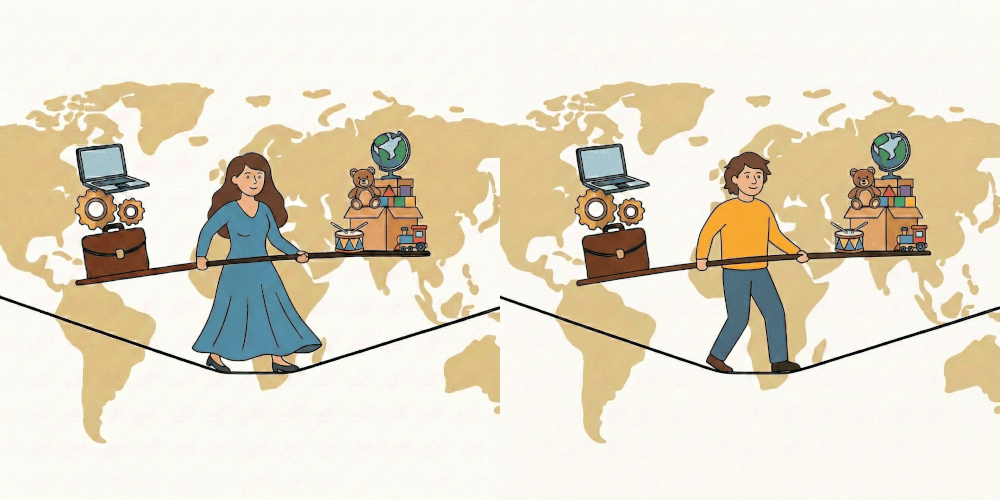
“Accompanying spouses and partners are critical to the success of overseas assignments, yet they frequently told us of feeling undervalued and underappreciated,” the report says. “From pre-departure formalities to settling in at post, accompanying spouses are often excluded from these administrative processes, leading to heightened stress and conflict. Situations ranging from high interpersonal tension to domestic violence are often kept silent. For accompanying spouses and partners, the connection to Canada is often through the CBS employee and seeking support can feel more distant and daunting in times when they most need the support.”
“The spouse has to put on pause their career and sometimes their sense of having an identity separate from the employee. For some people, this can be a heavy emotional toll.” Daniel Campeau, Deputy Ombud
Daniel Campeau, Deputy Ombud, adds in an interview that spousal employment and career management are significant concerns for many visitors. In that sense, postings can come “with a great sacrifice in terms of personal and professional autonomy. The spouse has to put on pause their career and sometimes their sense of having an identity separate from the employee. For some people, this can be a heavy emotional toll.”
Kids’ adaptation is another issue. “For young children, most of the time it’s ok, because their social lives revolve around their parents,” Campeau says. “But for tweens and teens, losing their friends can be very difficult, and making new friends can be a challenge. We do offer every spring pre-posting sessions for parents of teens and tweens, and for the teens and tweens themselves.”
FSDs and medical insurance
The report highlights a couple of particular administrative stressors: having to manage and navigate Foreign Service Directives (FSDs), and medical insurance.
“Many employees on posting expressed frustrations about what they perceive to be the inflexible application of certain FSDs, especially those in very high-risk missions or when there has been a mandatory evacuation of employees or family members. We have heard how the administrative burden of FSDs, including delays in processing claims, was a source of stress and, in some cases, financial hardship.”
Medical insurance. Oh boy. “Because of gaps in coverage due to delays in approvals and claims processing by MSH International, CBS and their families were faced with a range of issues,” the report says. “These included problems related to general stress, well-being and their overall health, as well as significant financial hardship. We heard from CBS carrying tens of thousands of dollars of debt. At the same time, CBS told us that they were forgoing or postponing medical visits for fear of the financial costs and that they lived in constant fear of potential medical emergencies. While acknowledging GAC’s efforts to make no-interest loans available to cover costs, some of you told us that you would avoid postings until the situation was resolved, resulting in a loss of talent for GAC at our missions abroad.”
Campeau says his impression is that the MSH issue is getting better. “There are still cases that are quite critical. It depends in part on the cost of healthcare in certain countries. In the U.S., for example, it’s very expensive so any type of medical intervention could cost numbers in five figures.”
It’s beyond the Office’s scope to fix the insurance problem, or to make the FSDs easier to deal with. But as the report says, the organization is on hand to ensure GAC understands the extent of the issues, giving diplomats and family members a way to voice their concerns and steer the department towards solutions.
Enhanced services, greater need
Campeau says the Office has been working with researchers at L’université de Montréal to enhance its services for people seeking support after traumatic events such as natural disasters and human-made crises. The Office is also in the process of hiring 3 more EAP counsellors, bringing the total to 8, to address what the Office sees as a growing need for its services, coinciding with two significant changes: less stigma with respect to accessing mental-health services, and the feeling that the world isn’t as stable as it used to be.
“There used to be a significant stigma because people didn’t want to appear vulnerable,” Campeau says. “But over time I think this has been normalized. Second, I think in the past 35 years, the world was more or less a stable place. Maybe starting with 9/11 — but I think it has accelerated now — the world seems more unstable and there are more social and psychological risks.”
Source : First Annual Ombud Report 2023 to 2024
If you want to know more about the Office of the Well-being Ombud and Inspector General, consider reading the report. It describes in more detail the Office’s work not only for spouses and family members, but also for employees, diving into topics such as workplace performance management, workplace conflicts and team dynamics, the challenge of supporting employee well-being in crises, and concerns for locally-engaged staff (LES).
The Office is currently working on the 2024-2025 version, scheduled to be published in October 2025.
To contact the Office and access the EAP for counselling support: [email protected].
Stefan Dubowski is a freelance writer and editor currently living in Taipei, Taiwan, accompanying his wife and parenting two teens. His trailing-spouse journey includes posts in Beijing, China, and Delhi, India.