
A little over 20 years ago, when my partner and I were considering our first posting abroad in Islamabad, eyes sparkling with excitement despite the worried looks on the faces of our loved ones, an older colleague gave my partner what he called his most important piece of advice:
“If you want your career abroad to be a success, make sure your spouse is happy…”
At the time, I found the comment odd, even a bit reductive. I was the employee’s accompanying partner, yes, but was I not responsible for my own happiness?
Once I arrived at post, I understood what he had meant. I was no longer “me,” a person with an unusual but effective professional background. I could no longer find inside me the resourceful consultant who could reinvent her livelihood at a time when the concept of digital nomads didn’t really exist. I was simply seen as “the employee’s spouse,” “the dependent.”
I had to slowly redefine myself, and find my own purpose. And now, four postings later, I still see wisdom in that seasoned colleague’s advice.
Over the past 20 years, I have met spouses who endured the foreign assignments, carrying in their heart a profound homesickness. I have seen employees who changed their career to save their marriage, and others who made major decisions about their next posting without really consulting their partner. I have also seen spouses who preferred not to ask too many questions but still managed to recreate their family cocoon from one country to another.
Some suffer more or less silently, convinced that everything would be better if they were back in Canada. There are also many who cherish this lifestyle, like I do, despite its very many challenges.
The days when diplomats (usually men) had wives who faithfully followed them and excelled at organizing diplomatic receptions at home are long gone. Aside from rare examples, Canadian society is no longer compatible with living such a life until retirement.
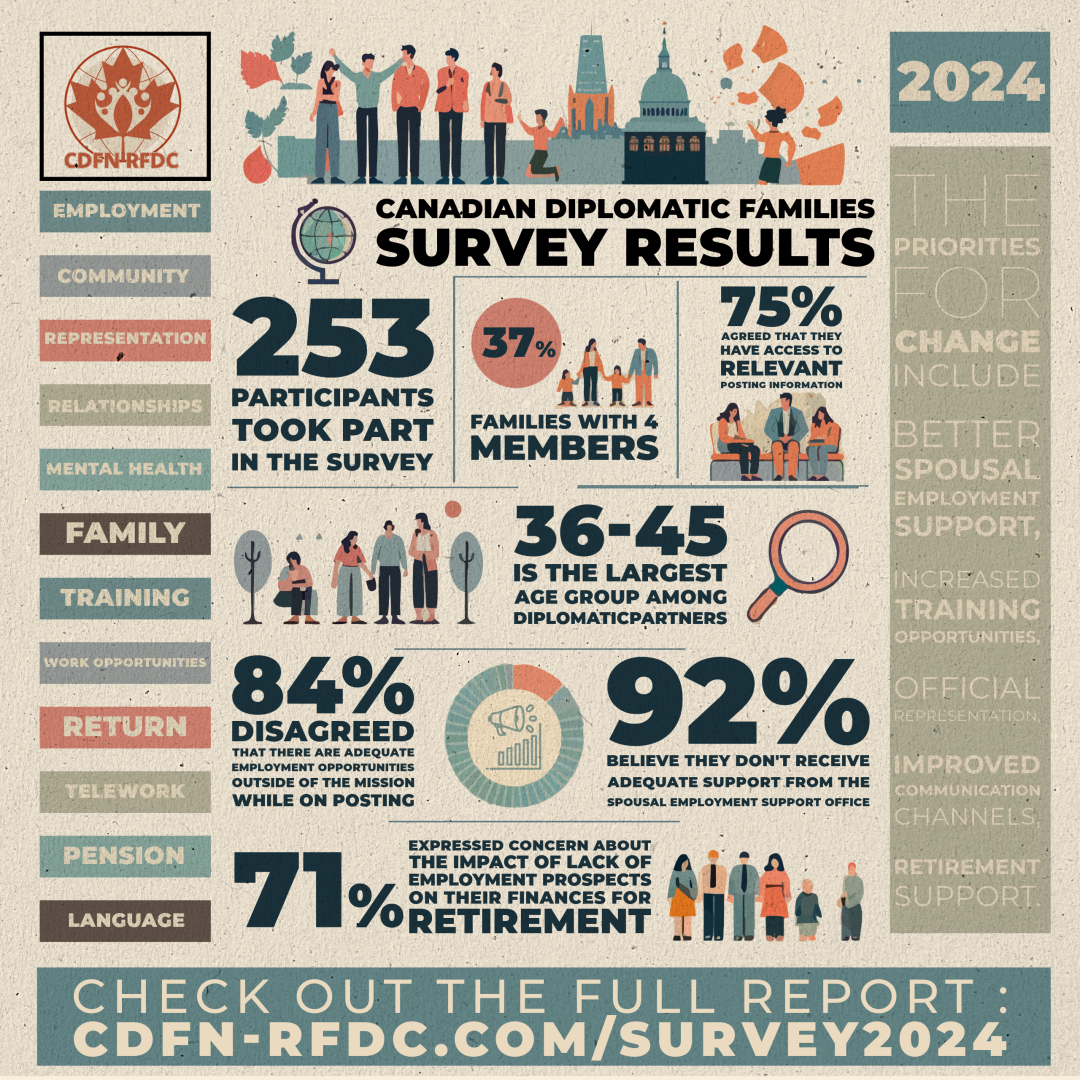
Nowadays, it is more common for both members of a couple to be in the workforce. Those who accompany their diplomat spouse abroad have either already begun a career in Canada, or were about to. Regardless of their desire to work (or not work) during a posting abroad, most spouses do worry about future employment in Canada and about their financial security for retirement.
Unfortunately, jobs that are easily transferable abroad are not common, and in most countries, spouses do not receive a work permit allowing them to obtain a job locally. Even when bilateral agreements or local laws make jobs possible, the salary can often be much lower than what one would earn in Canada.
From a career perspective, spouses face serious challenges. Most need to put their professional aspirations on hold, or at least learn to reassess their career goals. A lucky few manage to maintain a career in Canada despite their years abroad by negotiating remote work arrangements, or unpaid leave which does increase their chances of resuming similar work upon return. However, for the majority, international living experience is not particularly valued, and career progression is dramatically slowed.
Passionate travelers will say that these sacrifices are offset by the wealth of experiences that they are fortunate enough to have. There are as many opinions on the subject as there are individuals. One thing is clear: spouses who draw on their experience abroad are particularly adept at adapting to change.
Who Am I If I Do Not Work?
In a new posting, a diplomat beginning work at an embassy will quickly gain a professional and social network. For those assigned with family, school-age children soon settle into routines largely shaped by school. In contrast, the daily priorities of the non-working partner are much less defined, even though family logistics often fall on the shoulders of the person who has more time on their hands.
“When you stop working for the first time in your adult life, it’s psychologically unsettling and can affect your sense of identity,”
says Marie-Andrée Poupart, the spouse of a Global Affairs Canada (GAC) employee stationed in the Middle East. For the third time, she put her career on hold to accompany her spouse with their two children. “It feels a bit like a deconstruction of who you are. At first, it can be really upsetting,” she says.
Suddenly finding themselves without an income, some people question their financial autonomy and even the principle of equality in their relationship. Many experience intense loneliness, while others find ways to thrive despite obstacles by engaging in activities that connect them with people sharing similar interests, and that help them enjoy their new environment.
Since it is crucial to ensure their children’s adaptation, parents use various strategies to build new support networks and friendships. They also help their children maintain long-term friendships despite frequent moves and distance. This is especially important for kids who started moving abroad at a young age and struggle to see Canada as “home.”
On the contrary, some will choose to keep a low profile and prefer to avoid social gatherings. Living in the same compound as embassy colleagues or constantly being identified as a foreigner can certainly heighten the feeling of lost privacy.
Learning to Function Again in Daily Life
Life abroad can lead to wonderful discoveries and extraordinary travels, but it can also mean a loss of freedom or autonomy due to security restrictions or local customs.
Some societies also operate on very different schedules and rhythms, and we find ourselves needing to adapt to new ways of thinking about efficiency and daily services.
Personal security issues can add major stress. Language barriers can also create difficulties, especially for spouses who do not have direct support from embassy staff or formal language training.
Living conditions vary greatly between developed and developing countries. These differences are often felt most by family members immersed in local life, doing the shopping and having to find solutions for everyday life. Eating “100% local” is not easy with children; many seek comfort in familiar foods and routines.
Childcare can also be scarce. Where does one find engaging, affordable day camps like in Canada? Parents who must care for young children full-time or be home mid-afternoon for school-age kids have limited work options, unless they can afford domestic help.
A family’s purchasing power can vary enormously from one posting to another, even though Foreign Service Directives attempt to mitigate financial differences. The initial shock can be significant, but most people adapt to the situation and to the host culture within six months.
Families may also have to deal with frequent power outages or seasonal weather conditions. Others face serious circumstances leading to evacuations for security or political reasons.
Resilience is best built at a young age, but does not always flourish easily. Think of a teenager trying to accept that the internet in his new country is too unstable for gaming, or another forced to leave her closest friends behind during an emergency evacuation. Maintaining family balance is far easier if parents can pass on a spirit of adventure and curiosity to their children.
Teenagers’ schooling presents additional challenges, particularly when switching between school systems. Even if the employer ensures a degree of compatibility, difficulties often arise when a move occurs around the last couple of years of high school. Some students must take extra courses to meet Canadian requirements, on top of adjusting to their new learning environment. Unlike in the past, GAC no longer sees the wish for a child to complete their high school diploma at post as a valid reason for a one-year posting extension.
Given all these challenges, it’s understandable that many spouses have little mental space left for professional fulfillment.
An Opportunity to Reshape Your Life
Seasoned expats know this: to be happy at post, you must take extra good care of yourself. Each assignment abroad can be an opportunity to tweak your “new life” according to evolving priorities. This leap into another world allows one to broaden interests and explore different sides of oneself: “Who am I now, in this Asian, Arab, or Latin country?” We are much more than dependents.
Spouses should be celebrated more often for their resilience. They are often the ones maintaining family cohesion without which the employee would not be able to perform so well from one posting to the next.
When professional opportunities do not arise, some seize the chance to pursue other goals: returning to school through online programs, or finally diving into creative projects (photography, painting, writing, etc.). Others start volunteering for an organization that is deeply meaningful for them, or undertake a fitness overhaul. Sometimes, it’s a mix of everything and it works!
For Marie-Andrée Poupart, not working at all was never an option. Though she has another career in Canada, she developed new interests abroad that led her to coaching training and she can now use her coaching skills anywhere. She believes her mental health is better for it, as she can create projects, lead workshops, and she never gets bored. More recently, she has devoted energy to the Canadian Diplomatic Family Network, where she serves as co-president.
To address the challenges of life in the Foreign Service, GAC offers psychological support services to employees and their dependents, for both personal and work-related issues. Many make use of these confidential services.
Those who thrive in life abroad are among the most fascinating people I have met. Once we are back in Canada, few people around us can fully grasp the complexity of what we lived through. But when we happen to meet people with whom we share this diplomatic background or a specific culture that has marked a few years of our lives, the understanding and camaraderie can be profound.
Without necessarily loving every new environment, we gradually learn to find balance, and from time to time, we may even find our very own sense of happiness.
(A shorter version of this text was originally published on the Global Affairs Canada website. The author presents an expanded version here.)
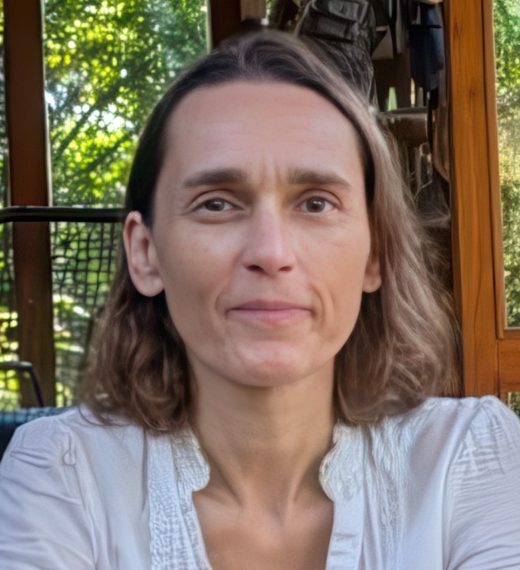
Geneviève Angers has explored more than forty countries as a freelance journalist, globetrotter, employee of Global Affairs Canada, and spouse of a diplomat. She is currently accompanying her spouse on his 4th posting in Asia.
Resources:
Professional identity and career
- The diplomatic spouse: Relationships between adjustment, social support and satisfaction with life
- Unlocking your potential with continuous learning
Psychological support and well-being
Family and parental support
Taxes
- “Coming soon”